


Gravure Printing
Gravure Printing Principle
Gravure printing derives its name from the word “engrave”, referring to the engraved cells that are created on the surface of a metal printing cylinder. Unlike relief or offset printing, gravure transfers ink from thousands of microscopic recessed cells directly onto the substrate.
Originally developed from Heliogravure technology in 1897, gravure printing has become one of the most widely used printing methods for high-volume packaging, decorative laminates, magazines, and flexible films due to its exceptional image quality and consistency.
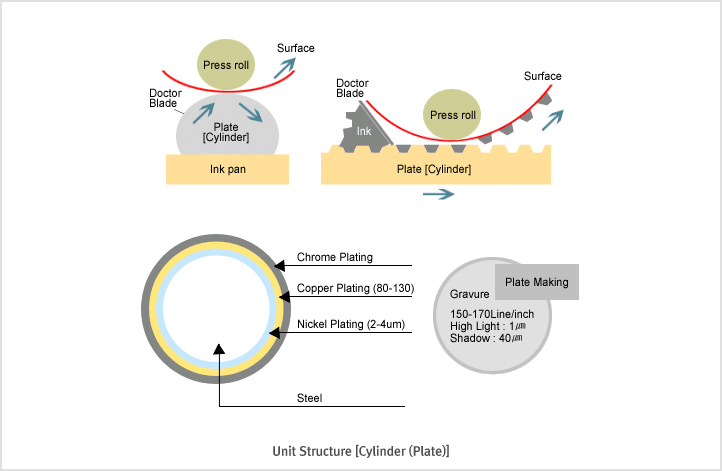
How Gravure Printing Works
In gravure printing, the image is engraved into the surface of a rotating cylinder. These engraved cells vary in depth and volume, allowing different amounts of ink to be transferred and producing smooth tonal gradations and high-resolution images.
The printing process consists of the following steps:
1. Ink Filling
As the gravure cylinder rotates through the ink pan, all engraved cells are filled with printing ink.
2. Doctor Blade Wiping
A Doctor Blade removes excess ink from the non-engraved surface of the cylinder, ensuring that ink remains only inside the engraved cells.
The doctor blade plays a critical role in print quality by controlling ink volume and preventing unwanted ink transfer.
Doctor Blade Characteristics:
- Typically manufactured from hardened steel.
- Standard thickness is approximately 70 μm.
- May be coated with ceramic, PTFE (Teflon), or other wear-resistant materials to improve durability and performance.
- Ensures clean cell definition and sharp image reproduction.
3. Ink Transfer
The substrate passes between the gravure cylinder and the Press Roll (Impression Roll).
Pressure applied by the press roll forces the substrate into contact with the engraved cells, drawing ink out of the cells and transferring it directly onto the printing surface.
This direct transfer mechanism enables gravure printing to achieve:
- Excellent color density
- Consistent print quality
- Smooth gradients
- High-speed production capability
Press Roll Function
The Press Roll provides the pressure necessary to transfer ink from the engraved cells onto the substrate.
Typical operating pressure ranges from 2 to 5 kg/cm depending on:
- Substrate type
- Cylinder diameter
- Surface lubricity
- Solvent resistance
- Required print quality
Proper selection of the rubber compound and hardness of the press roll is essential for maintaining consistent ink transfer and minimizing print defects.
Gravure Cylinder Structure
A gravure cylinder is a highly engineered component consisting of multiple metal layers:
| Layer | Function |
|---|---|
| Steel Core | Provides structural strength and rigidity |
| Nickel Layer (2–4 μm) | Improves adhesion and corrosion resistance |
| Copper Layer (80–130 μm) | Engraving layer where image cells are created |
| Chrome Layer | Provides wear resistance and extended cylinder life |
The image is engraved into the copper layer before being chrome plated to protect the cylinder during long production runs.
Typical gravure cell depths range from:
- Highlight areas: approximately 1 μm
- Shadow areas: up to 40 μm
Deeper cells carry more ink, producing darker tones, while shallower cells transfer less ink, creating lighter image areas.
Advantages of Gravure Printing
- Exceptional image quality and color consistency
- Excellent reproduction of fine details and gradients
- Suitable for very long production runs
- High printing speeds
- Wide compatibility with films, foils, paper, and flexible packaging materials
Because of these advantages, gravure printing remains a preferred technology for premium packaging, decorative printing, and high-volume commercial printing applications worldwide.
| Description | Conve | Gravure(Net) | Hellio |
| Plate Making | Corrosion | Corrosion | Engraving |
| Cell Capacity | Large | Large | Small |
| Feature | Different levels of depth on the same plate | – | Equal depth throughout the entire plate |