


Offset Printing
Offset Printing Principle
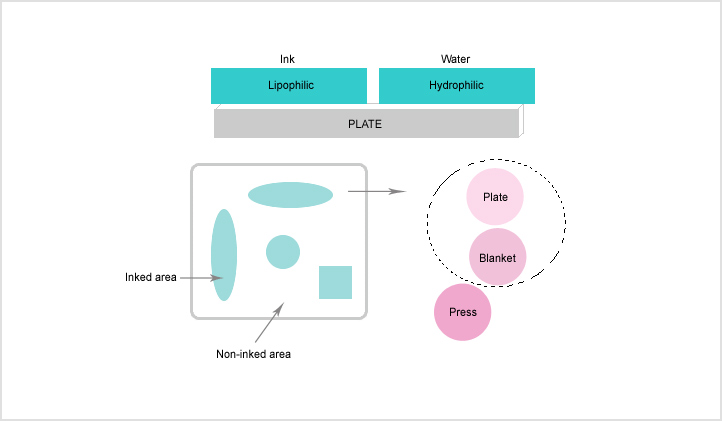
Offset printing is based on the physical and chemical repulsion between ink and water. The printing plate contains two distinct areas:
- Image areas (ink-receptive areas): These areas are oleophilic (lipophilic), meaning they attract ink and repel water.
- Non-image areas (water-receptive areas): These areas are hydrophilic, meaning they attract water and repel ink.
During printing, a thin film of fountain solution (a mixture of water and additives such as alcohol or alcohol substitutes) is first applied to the plate. The fountain solution covers the non-image areas, preventing ink from adhering to them. Ink is then applied and adheres only to the image areas.
The inked image is transferred from the printing plate to a rubber blanket cylinder and then onto the substrate (paper, paperboard, or other materials). Because the image is transferred indirectly through the blanket, this process is known as offset printing.
Unlike relief, gravure, or screen printing, offset printing uses a flat printing plate. The distinction between printing and non-printing areas is achieved through the different surface properties of the plate rather than differences in height.
Key Characteristics
- Uses the principle of oil-and-water repulsion.
- Employs a flat printing plate with no raised or recessed image areas.
- Produces high-quality images with excellent detail and color consistency.
- Suitable for high-volume commercial printing applications.
Figure Explanation
The diagram illustrates how the offset printing process works:
- The plate surface contains lipophilic image areas and hydrophilic non-image areas.
- Fountain solution wets the non-image areas.
- Ink adheres only to the image areas.
- The inked image is transferred to the blanket cylinder.
- The blanket cylinder transfers the image onto the printing substrate through pressure.
This indirect image transfer is one of the main reasons offset printing delivers consistent print quality and long plate life.