


Flexo Printing
Flexographic Printing Principle (Flexo Printing Principle)
Flexographic printing, commonly known as Flexo Printing, is a modern relief printing process in which ink is transferred from raised image areas directly onto the substrate. The printing plate contains embossed (raised) image elements that receive ink and transfer it to the printing surface.
Originally derived from traditional letterpress printing, flexography has evolved into one of the most widely used printing technologies for packaging, labels, corrugated boxes, flexible films, paper products, and other high-volume applications.
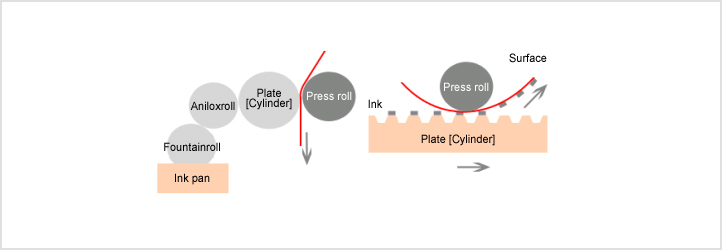
Flexo Printing Principle
In flexographic printing, ink is applied only to the raised image areas of a flexible printing plate. The inked image is then transferred directly onto the substrate under controlled pressure.
Unlike gravure printing, where ink is held in engraved cells, flexographic printing utilizes a raised printing surface. The process enables high-speed production while maintaining excellent print quality on a wide variety of materials.
How Flexo Printing Works
1. Ink Supply System
Ink is stored in an Ink Pan and transferred to the Anilox Roll, which plays a critical role in controlling ink volume.
2. Anilox Roll Metering
The Anilox Roll contains thousands of microscopic engraved cells that precisely meter a controlled amount of ink.
As the roll rotates through the ink pan, the cells are filled with ink and excess ink is removed, leaving a consistent ink volume on the roll surface.
3. Plate Inking
The measured ink is transferred from the anilox roll to the raised image areas of the flexible printing plate mounted on the plate cylinder.
Only the raised portions of the plate receive ink, while the non-image areas remain clean.
4. Image Transfer
The substrate passes between the plate cylinder and the Press Roll (Impression Cylinder).
Pressure applied by the press roll transfers the ink directly from the raised plate surface onto the substrate, producing the final printed image.
Anilox Roll Function
The Anilox Roll is one of the most important components in flexographic printing.
Its primary functions include:
- Metering a precise amount of ink.
- Ensuring consistent ink transfer.
- Improving print quality and color stability.
- Reducing ink waste.
Anilox rolls are typically manufactured with ceramic-coated surfaces and laser-engraved cells of various volumes and line counts to suit different printing requirements.
Plate Cylinder
The Plate Cylinder carries the flexible photopolymer printing plate.
Modern flexographic plates offer:
- High image resolution.
- Excellent durability.
- Consistent ink transfer.
- Compatibility with UV, water-based, and solvent-based inks.
The flexibility of the plate allows printing on uneven and flexible materials such as films, labels, and corrugated board.
Press Roll (Impression Cylinder)
The Press Roll provides the pressure required for transferring ink from the plate to the substrate.
Proper pressure settings are critical for:
- Maintaining image sharpness.
- Preventing dot gain.
- Achieving uniform ink density.
- Minimizing print defects.
Advantages of Flexo Printing
- High-speed production capability.
- Suitable for long printing runs.
- Compatible with paper, film, foil, plastic, and corrugated board.
- Supports water-based, solvent-based, and UV-curable inks.
- Lower operating costs for large-volume production.
- Environmentally friendly options using water-based inks.
Typical Applications
Flexographic printing is widely used for:
- Flexible packaging
- Food packaging
- Labels and stickers
- Corrugated cartons
- Paper bags
- Plastic films
- Tissue and hygiene products
- Folding cartons
Because of its versatility, efficiency, and ability to print on a wide range of substrates, flexographic printing remains one of the dominant printing technologies in the global packaging industry.